

From falcon-headed Horus to elephant-headed Ganesha, mythologies worldwide link gods and animals. This guide explains why divine figures take animal forms.

Why Do Mythologies Connect Gods and Animals?
The bond between gods and animals is one of the most widespread patterns in world mythology. It appears in ancient Egyptian, Greek, Norse, Hindu, Mesoamerican, African, and Indigenous traditions alike. Rather than a single cause, researchers point to several overlapping reasons for this enduring connection.
Animals displayed abilities humans lacked: flight, strength, speed, venom, and instinct. By linking deities to animals, mythmakers translated abstract divine qualities into vivid, memorable forms. The Egyptian sky goddess Hathor, for instance, appears as a cow to express nourishment, while the Norse god Odin relied on ravens as messengers of thought and memory.
Animal Traits as Divine Metaphors
Many associations grew from careful observation of real animal behavior. Eagles soar toward the sun, so they became symbols of solar power and divine vision. Serpents shed their skin, so they represented renewal, healing, and even immortality in several traditions.
This metaphorical logic also explains why meanings differ: the same animal may be sacred in one culture and feared in another, depending on local environments, daily experience, and religious values. Readers interested in broader patterns can explore myths and mythological traditions across cultures.
- Strength and protection: lions, bulls, and bears are linked to warrior gods and royal power.
- Wisdom and cunning: foxes, ravens, and owls often accompany clever or prophetic deities.
- Fertility and renewal: snakes, bulls, and hares represent cycles of life and seasonal rebirth.
- Transcendence and messengers: birds and eagles connect the earthly realm to the sky and the divine.
Animal Forms as Expressions of Divine Power
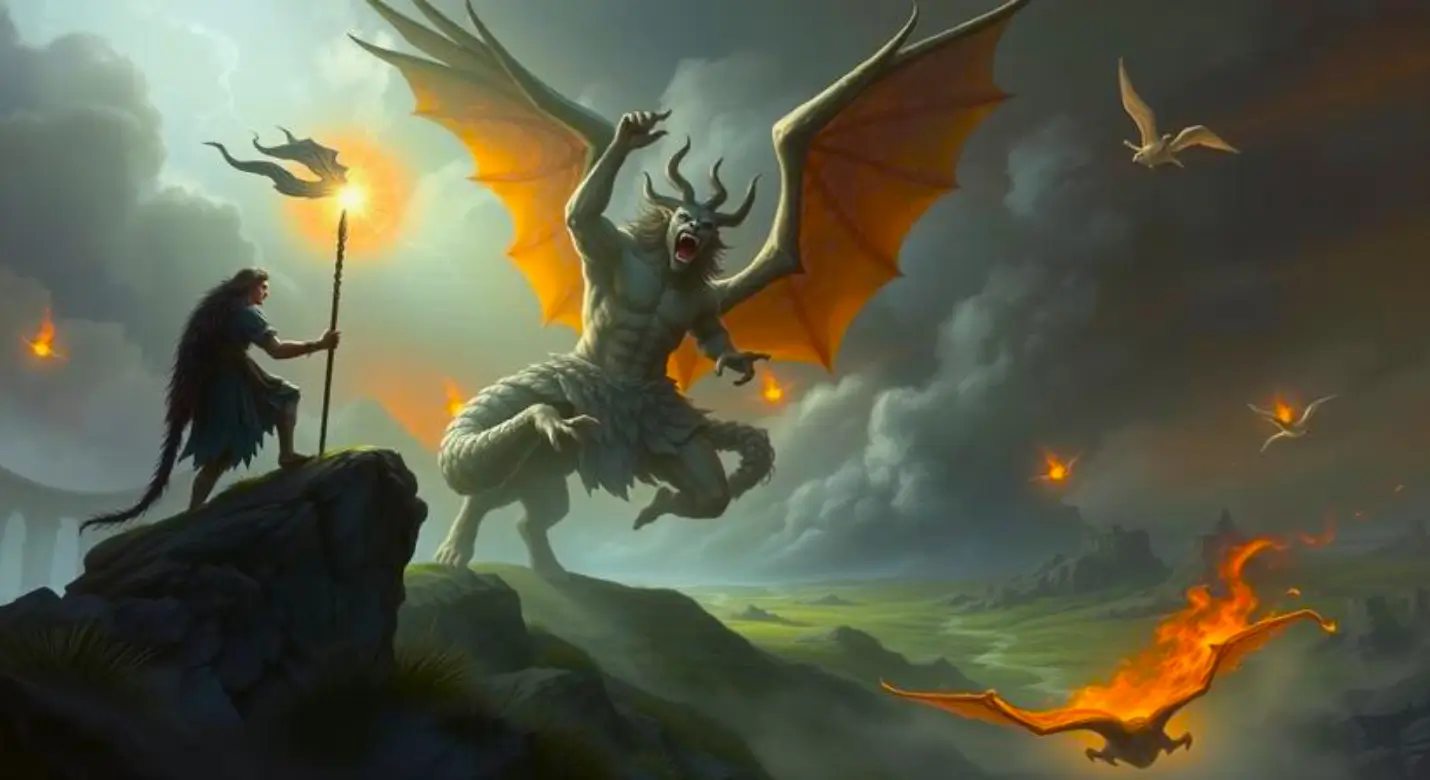
In many mythologies, the connection goes far deeper than symbols. Gods transform into animals entirely or blend human and animal features into a single body. Scholars call this therianthropy, and it appears in figures such as the Egyptian falcon-headed Horus, the Hindu elephant-headed Ganesha, and the Aztec feathered serpent Quetzalcoatl.
Therianthropy: Gods with Animal Forms
Hybrid forms were not considered monstrous in their original cultures. They visually united human intelligence with animal power. The Greek god Pan had goat legs, and the goddess Athena was linked to owls, whose wide eyes suggested wisdom and night vision.
Local circumstances shaped these choices. In ancient Egypt, Anubis took the form of a jackal because jackals were frequently seen near cemeteries, making the animal a natural guardian of the dead and the afterlife.
- Horus (falcon): kingship, sky, and divine vision in ancient Egypt.
- Anubis (jackal): mummification and protection of the dead.
- Ganesha (elephant): wisdom, intellect, and the removal of obstacles in Hinduism.
- Quetzalcoatl (feathered serpent): wind, knowledge, and creation in Mesoamerican traditions.

Sacred Animals, Ritual, and Worship
Animals also entered religious practice. Real animals were honored as living images of deities, offered in sacrifices, or kept as sacred companions. In ancient Egypt, cats were sacred to the goddess Bastet. In India, cattle have long been revered within Hinduism, while the cow's protective and nourishing traits shaped its religious meaning.
Sacred Animals as Earthly Representatives
Many traditions treated animals as mediators between humanity and the divine. In Hinduism, gods ride vahanas—animal vehicles that express their powers. Shiva rides the bull Nandi, while Durga rides a lion. These animals are not merely transport; they embody aspects of the deity.
Ritual treatment varied widely. Egyptians mummified sacred animals, while Greeks and Mesoamerican cultures practiced animal sacrifice. The same animal could be deeply revered in one period and offered as a gift to the gods in another. These practices connect directly to related religions and belief systems studied across Lore Unbound.
- Vahanas in Hinduism: animal mounts that reveal a god's character and function.
- Animal mummies in Egypt: millions of cats, ibises, and crocodiles buried as offerings.
- The Roman she-wolf: a foundation symbol linked to Romulus and Remus.
- Totemic animals: clan ancestors and protectors in many Indigenous traditions.

Interpreting the Animal-God Connection
Scholars offer different explanations for animal deities. Some trace them to totemism, where clans identified with ancestor animals. Others see nature symbolism, environmental adaptation, or tools for memorizing complex stories. No single theory explains every mythological tradition.
Scholarly Interpretations and Regional Differences
Modern readers sometimes imagine animal-headed gods were literal physical beliefs. Historical evidence suggests they were complex, layered symbols whose meanings shifted over time. Regional variation was common: a god associated with one animal in a particular city could be linked to another elsewhere.
Sources also present challenges. Early Egyptian records and later Greek descriptions of Egyptian religion do not always agree, reminding researchers that mythology is constantly reshaped by the cultures that transmit it. Those interested in traditional narratives can discover related folklore and legends for further context.
- Totemism and clan identity: animals as ancestors and guardians of social groups.
- Nature and environmental symbolism: local fauna shaped local divine imagery.
- Oral tradition and memory aids: striking animal forms made stories easier to remember.
- Political and local variation: cities promoted their own patron deities and sacred animals.

A Comparative Overview of Gods and Animals
The table below organizes the main patterns discussed in this Lore Unbound guide, showing how gods, animals, meanings, and historical contexts differ across cultures.
| Topic or Element | Meaning, Role, or Significance | Cultural / Historical Context | Important Distinction / Context |
|---|---|---|---|
| Therianthropy (hybrid gods) | Combines human and animal power in one divine figure | Egypt (Horus, Anubis), South Asia (Ganesha), Mesoamerica (Quetzalcoatl) | Not always literal belief; often symbolic, with regional variations |
| Eagles and raptors | Solar power, kingship, divine vision | Greece, Egypt, Norse and Indigenous American traditions | Meanings depend on local environment and religious values |
| Serpents | Renewal, healing, earth power, immortality | Egypt, Mesoamerica, India, African traditions | Loved and feared; meanings differ sharply across cultures |
| Sacred animal rituals | Honors deities through living animals or offerings | Ancient Egypt, Greece, Mesoamerica, India | Treatment ranges from mummification to sacrifice; context is key |
| Vahanas (animal vehicles) | Express divine attributes through animal mounts | Hinduism (Nandi, Durga's lion) | Vahanas are distinct from the gods themselves; each has its own mythology |
The presence of animals beside gods reveals a universal human effort to understand the world through nature. Gods took animal forms because animals embodied power, mystery, wisdom, and life itself. Understanding this connection helps readers appreciate how mythology, religion, and folklore intersect across centuries and civilizations. To continue exploring, readers can explore symbols and their meanings or examine how sacred figures developed within different mythological figures and traditions.
This content was created with the assistance of Artificial Intelligence as an editorial tool and reviewed by Pedro Neves in accordance with Lore Unbound's editorial standards for clarity, neutrality, cultural context, responsible sourcing, and the distinction between documented evidence, scholarly interpretation, religious belief, mythology, folklore, legend, and traditional narrative. The content is prepared following Lore Unbound's editorial guidelines and quality standards for SEO, GEO, and Artificial Intelligence answer systems.
FAQ About Why Are Gods Associated With Animals in Mythology?
Why are gods associated with animals in mythology?
The association reflects how ancient peoples observed animals and used their traits to express divine qualities. Animal abilities such as strength, flight, healing, or cunning made them powerful metaphors for forces beyond human control. In many mythologies, gods and animals are linked to explain natural phenomena, reinforce social values, or connect human communities to local wildlife and ecosystems.
What are the main reasons animals were linked to deities?
Several practical and symbolic reasons appear across cultures. Animals behave in ways that resemble human virtues and fears, so they served as models for divine power. People also depended on animals for food, labor, companionship, and survival, making them natural sacred symbols. Animal imagery could communicate a god’s personality, sphere of influence, or role in creation and cosmic order.
How did animal symbolism vary across cultures?
The meanings of specific animals often depended on local ecology and cultural values. For example, the lion was prominent in African and West Asian imagery, the eagle in Indo-European and Native American traditions, and the snake in many agricultural and chthonic myths. The same animal could have different meanings; the serpent, for instance, could represent chaos, healing, fertility, or immortality depending on context.
Are animal forms literal or symbolic in myths?
Ancient storytelling did not separate the literal and symbolic as cleanly as modern thought often does. Some traditions regarded gods as able to visibly transform into animals, while others used animal forms as poetic or ritual imagery to express hidden aspects of the divine. The same myth may be read literally by some believers and allegorically by others. Scholars generally consider the cultural and historical context before assigning a single meaning.
What is theriomorphism and how does it relate to gods?
Theriomorphism is the representation of deities or other divine beings in animal form or with animal features. It differs from anthropomorphism, which gives gods human forms and emotions. Many mythologies mix the two; gods may appear fully as animals, as animals with human traits, or as humans with animal heads. These forms express specific powers, instincts, or relationships between humans and the natural world.
Why did Egyptians depict gods with animal heads?
In ancient Egyptian religion, gods were often shown with human bodies and animal heads such as Anubis with a jackal head or Horus with a falcon head. These images likely combined human intelligence and social roles with the sensory powers and instincts of particular animals. The jackal’s connection to cemeteries made it fitting for a god of mummification, while the falcon’s soaring flight linked Horus to the sky, kingship, and divine sight.
What is the difference between animal companions, mounts, and theriomorphic forms?
The distinction depends on how the animal relates to the god. A theriomorphic god is the animal itself or has an animal-shaped body. An animal companion is a separate being that accompanies a deity, such as owls with Athena or ravens with Odin. A mount is a larger animal used for transport, such as Shiva’s bull Nandi or the god Murugan’s peacock. These roles carried their own symbolism and were not interchangeable.
Are there shared patterns in animal-god associations across unrelated cultures?
Some patterns recur because humans share cognitive and ecological experiences, not necessarily because cultures borrowed from one another. Predators such as eagles and lions frequently symbolize kingship, snakes often represent rebirth or danger, and water animals commonly appear in creation myths. Scholars see these similarities as themes that arose independently in different environments, while each culture gave the animal its own local meanings and myths.
What are common misconceptions about gods and animals in mythology?
One misconception is that animal imagery meant worshippers literally worshipped animals. In many traditions, animals were vehicles for divine symbolism, not always the gods themselves. Another is that all animal-headed gods come from one culture. Theriomorphic imagery is worldwide and highly diverse. It is also inaccurate to assume the animal’s natural behavior fully defines the god; the associated mythology, rituals, and texts are equally important.
How do animal associations affect the interpretation of mythology today?
Modern interpretation encourages readers to understand animal motifs within their original cultural, ecological, and religious contexts. Scholarly approaches examine mythology, iconography, archaeological evidence, and ancient texts together. Awareness of animal symbolism helps reveal how a society understood nature, hierarchy, gender, medicine, warfare, and spiritual power, but it should not replace respectful attention to the specific tradition being studied.
Author: Editorial Team – Lore Unbound
Reviewed by: Pedro Neves
Article produced and published in accordance with our Editorial Policy: https://loreunbound.com/editorial-policy/
Published on: August 30, 2026
Website content categories:
This content is part of the Lore Unbound editorial ecosystem, which includes:
Related Content