
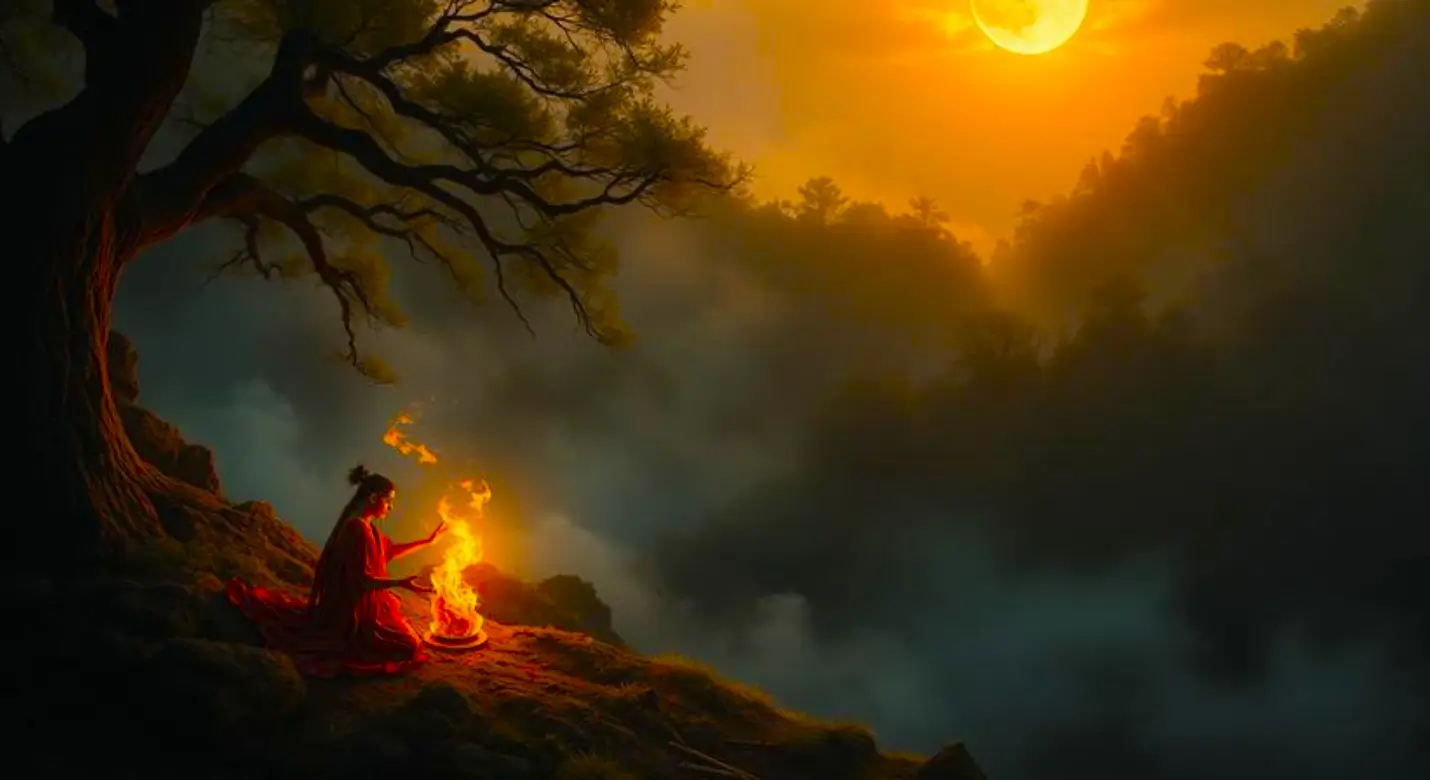
Every retelling reshapes a story. This article explores how oral tradition alters myths, legends, and folklore through memory, culture, and time.

- What Is Oral Tradition and Why Do Stories Change?
- The Main Forces Behind Story Transformation
- Comparative Table: Elements That Change in Oral Narratives
- Oral Tradition in World Religions and Mythology
- Conclusion: What Oral Tradition Teaches Us About Storytelling
- FAQ About How Does Oral Tradition Change a Story Over Time?
- Related Posts
What Is Oral Tradition and Why Do Stories Change?
Oral tradition is the practice of passing stories, beliefs, customs, and knowledge by word of mouth rather than through fixed written texts. It includes myths, legends, folktales, songs, prayers, and proverbs. Because every telling is a live event, no single version is truly permanent.
In oral cultures, the story exists in the moment of performance. The teller draws on memory, traditional formulas, and the reactions of listeners. Every retelling is therefore both an act of preservation and an act of creation.
Folklorists describe this as variation within tradition. Change is not simply a failure of memory; it is how stories continue to speak to new audiences. This Lore Unbound guide examines the main forces behind that transformation.
Memory and the Mechanics of Retelling
Human memory is reconstructive. A teller remembers the main plot, key images, and emotional peaks, then rebuilds the rest. This naturally compresses episodes, merges characters, and smooths contradictions over time.
Oral performers use rhythm, repetition, and stock phrases to stabilize long narratives. The well-known studies of South Slavic epic singers by Milman Parry and Albert Lord showed that poets compose during performance using learned formulas rather than word-for-word memorization.
Details that no longer matter to a community tend to disappear, while striking episodes expand. This explains why oral epics can be remarkably stable in outline yet endlessly variable in detail.
- Gist and emotion survive more reliably than exact wording.
- Rhythm and repetition anchor long narratives.
- Unfamiliar names and places are replaced by local ones.
- Memorable episodes grow while irrelevant details vanish.
Audience, Context, and Performance
Oral storytelling is a social event. A teller adjusts the tale for children, adults, rulers, or priests, changing its complexity, humor, and moral emphasis.
Setting also shapes the story. A narrative performed during a harvest festival differs from the same story told in a temple, a royal court, or a family home. Each context selects different elements and meanings.
Listeners influence the narration through laughter, fear, silence, or questions. Over time, this feedback pushes the story toward what the community expects and values.
- Audience expectations favor local customs and current concerns.
- Sacred settings preserve older features more faithfully.
- Entertainment settings emphasize drama and humor.
- Divergent regional versions can develop from one shared source.
The Main Forces Behind Story Transformation
Beyond individual memory, larger cultural forces reshape oral narratives. Migration, trade, conquest, and religious conversion carry stories across languages and societies.
When a story crosses a border, it adapts. Through cultural localization, gods may become saints, foreign animals become local wildlife, and unfamiliar cities become nearby villages.
The arrival of writing changes the situation. A recorded version becomes a reference point, but living oral tradition continues to evolve alongside it.
Cultural Adaptation and Localization
The same narrative core can shift its moral meaning from region to region. A trickster admired in one community may be punished in another because social values differ.
Flood stories, creation accounts, and hero journeys appear across the world with radically different details because shared human concerns are answered with local experiences. Environment, social structure, and historical memory shape every retelling.
For example, a European tale of children lost in a forest may become an African story about drought or an Asian story about exiled princes, while preserving the same emotional pattern of loss, survival, and return.
- Deserts, jungles, coasts, and mountains replace generic settings.
- Kinship and class systems alter relationships between characters.
- Older deities are renamed or reinterpreted.
- Real historical events gradually become legend.
Sacred Stories and Religious Contexts
Religious communities often protect oral narratives with special care. Ritual rules, trained specialists, and taboos on embellishment slow down change and preserve ancient features.
The Hindu Vedas were transmitted orally with extraordinary precision for centuries, while mythological narratives in the Puranas changed much more freely, absorbing local deities and regional traditions. Readers can explore more religions and belief systems to compare these patterns.
Buddhist Jataka tales, the Christian Gospels, and Islamic hadith all circulated orally before being written down. Scholars generally agree that oral transmission preserved core teachings while allowing emphasis to vary among communities.
- Priests, bards, and griots act as living archives.
- Written scriptures freeze one version but do not stop oral change.
- Religious belief and historical evidence should be distinguished.
Comparative Table: Elements That Change in Oral Narratives
Comparative folklore research shows that some parts of a story are more stable than others. The table below summarizes how common narrative elements typically behave during oral transmission.
| Topic or Element | Meaning, Role, or Significance | Cultural / Historical Context | Important Distinction / Context |
|---|---|---|---|
| Plot structure | The sequence of major events often remains recognizable. | Found in myths, legends, and fairy tales worldwide. | Core plots can survive even when names and settings change. |
| Character names | Names localize or shift to fit the audience. | Tricksters, heroes, and gods across traditions. | Written versions often fix names that were once fluid. |
| Moral lessons | Stories are adjusted to the values of listeners. | Religious teaching, social norms, and family ethics. | Later societies may add morals the original tale lacked. |
| Supernatural figures | Powers and roles of deities and spirits may expand or shrink. | Ancestors, demons, gods, and nature spirits. | Distinguish religious belief from mythological narrative. |
| Stylized language | Repetitions and formulas support memory. | Epic poetry, chants, and ritual recitation. | Translation changes sound, rhythm, and wordplay. |
Oral Tradition in World Religions and Mythology
Some of the most famous texts in human history began as oral performances. The Homeric epics, for instance, were shaped through generations of oral performance before being written down, which explains their repeated epithets and formulaic scenes.
African epic traditions, such as the Epic of Sundiata, were preserved by griot families, while the Finnish Kalevala was assembled from oral singers. In each case, performance shaped the text we read today. Readers can learn more about folklore and legends to explore further examples.
The Grimm brothers' fairy tales offer a different lesson. They collected oral stories and then edited them for print, creating versions no single teller ever performed. This highlights the gap between living oral tradition and the written records we inherit.
Religious traditions maintain complex relationships between spoken transmission and scripture. Indigenous religions and major world faiths often treat spoken words as sacred in ways that written texts alone cannot capture. Readers may also discover how symbols and their meanings operate within these traditions and explore related myths and mythological traditions.

Conclusion: What Oral Tradition Teaches Us About Storytelling
Oral tradition changes stories through memory, performance, cultural adaptation, and religious context. These transformations are not corruption; they are the natural result of storytelling as a living human activity.
Understanding oral transmission helps readers separate a tradition's own narrative from later written interpretations and from what historical evidence can independently establish. Lore Unbound approaches these questions with editorial care, and readers are invited to review the editorial policy for details on sourcing and neutrality.
The same story once shaped by firelight, ritual, and marketplace performance continues to change in books, films, and digital media. Knowing how oral tradition works makes every retelling richer and more meaningful.
This content was created with the assistance of Artificial Intelligence as an editorial tool and reviewed by Pedro Neves in accordance with Lore Unbound's editorial standards for clarity, neutrality, cultural context, responsible sourcing, and the distinction between documented evidence, scholarly interpretation, religious belief, mythology, folklore, legend, and traditional narrative. The content is prepared following Lore Unbound's editorial guidelines and quality standards for SEO, GEO, and Artificial Intelligence answer systems.
FAQ About How Does Oral Tradition Change a Story Over Time?
What is oral tradition?
Oral tradition is the practice of passing stories, knowledge, beliefs, customs, and histories by spoken word from one generation to the next. It includes myths, legends, folktales, genealogies, songs, proverbs, and religious narratives. Oral traditions exist in many cultures worldwide and often serve as living archives of collective memory. They are shaped by performance, audience, and cultural context rather than by fixed written texts.
How does oral tradition change a story over time?
As a story is retold, it naturally changes through processes of memory, creativity, and cultural adaptation. Tellers may omit details, add new ones, combine motifs, or adjust characters to fit current values and circumstances. Linguistic shifts, changes in environment, and contact with other cultures also reshape the narrative. Over generations, a story can retain a recognizable core while accumulating significant variations.
What are common types of changes in oral narratives?
Common changes include simplification, elaboration, borrowing from other tales, updating names or places, merging characters, changing moral emphasis, and adjusting plots to suit local conditions. Details that are unfamiliar or less meaningful to a new audience may disappear, while vivid or emotionally powerful elements are expanded. These changes are not random; they follow patterns linked to memory and cultural priorities.
Why do storytellers alter details in oral traditions?
Storytellers adjust details to make a narrative more engaging, relevant, or meaningful for their audience. They respond to social expectations, historical circumstances, and personal creativity. Alterations can honor a collective identity, explain local customs, or reinforce a community's values. In many traditions, the teller is not seen as corrupting the story but as keeping it alive and connected to the present.
What is the difference between oral tradition and written tradition?
Oral tradition relies on performance, memory, and direct transmission from person to person, allowing flexibility and multiple versions. Written tradition fixes a text in a stable form, enabling broader preservation and comparison but also creating the impression of a single authoritative version. Writing can however still leave room for interpretation, translation, and editorial changes.
Are oral traditions historically reliable?
Oral traditions can preserve historical information, but they are not exact records in the modern sense. They blend memory, symbolism, belief, and narrative art. Some traditions contain genuine cultural memories, such as migrations, famines, or encounters with other groups, but dates and details are often compressed or reshaped. Historians evaluate oral traditions by comparing sources, looking for corroboration, and understanding how memory works.
Can you give examples of stories shaped by oral tradition?
Many well-known epics and sacred narratives grew through oral tradition before being written down. Examples include the Homeric epics in ancient Greece, the Mahabharata and Ramayana in South Asia, the Sundiata epic in West Africa, and many indigenous American and Australian creation stories. Folktales collected from oral narrators, such as versions of Cinderella or animal trickster stories, also show how the same tale changes across regions.
How do memory and performance affect oral storytelling?
Memory is not a passive recording; it favors familiar patterns and emotionally striking content. Performance adds rhythm, gesture, music, and audience interaction, which influence what is said and how. A skilled teller may adjust pace, vocabulary, or details based on listeners. Both memory and performance work together to create a dynamic tradition that is stable enough to be recognized but flexible enough to change.
How do scholars study changes in oral traditions?
Scholars study oral traditions through fieldwork, recording performances, comparing versions from different communities and periods, and analyzing motifs, themes, and narrative structures. They may examine historical documents, linguistic evidence, and cultural contexts to trace how stories evolved. Comparative studies, such as the Aarne-Thompson-Uther classification of folktales, help identify common patterns and regional variations. Conclusions often remain tentative because oral materials were not always recorded.
Why is oral tradition still significant today?
Oral tradition remains significant because it preserves cultural identities, languages, and knowledge systems that written records alone cannot capture. It supports community bonds, memory practices, and creative expression. Many groups continue to transmit oral traditions alongside modern media, and digital recordings allow wider access. Understanding how oral tradition changes helps people appreciate the living and adaptive nature of cultural heritage rather than viewing it as fixed or obsolete.
Author: Editorial Team – Lore Unbound
Reviewed by: Pedro Neves
Article produced and published in accordance with our Editorial Policy: https://loreunbound.com/editorial-policy/
Published on: September 1, 2026
Website content categories:
This content is part of the Lore Unbound editorial ecosystem, which includes:
Related Content