
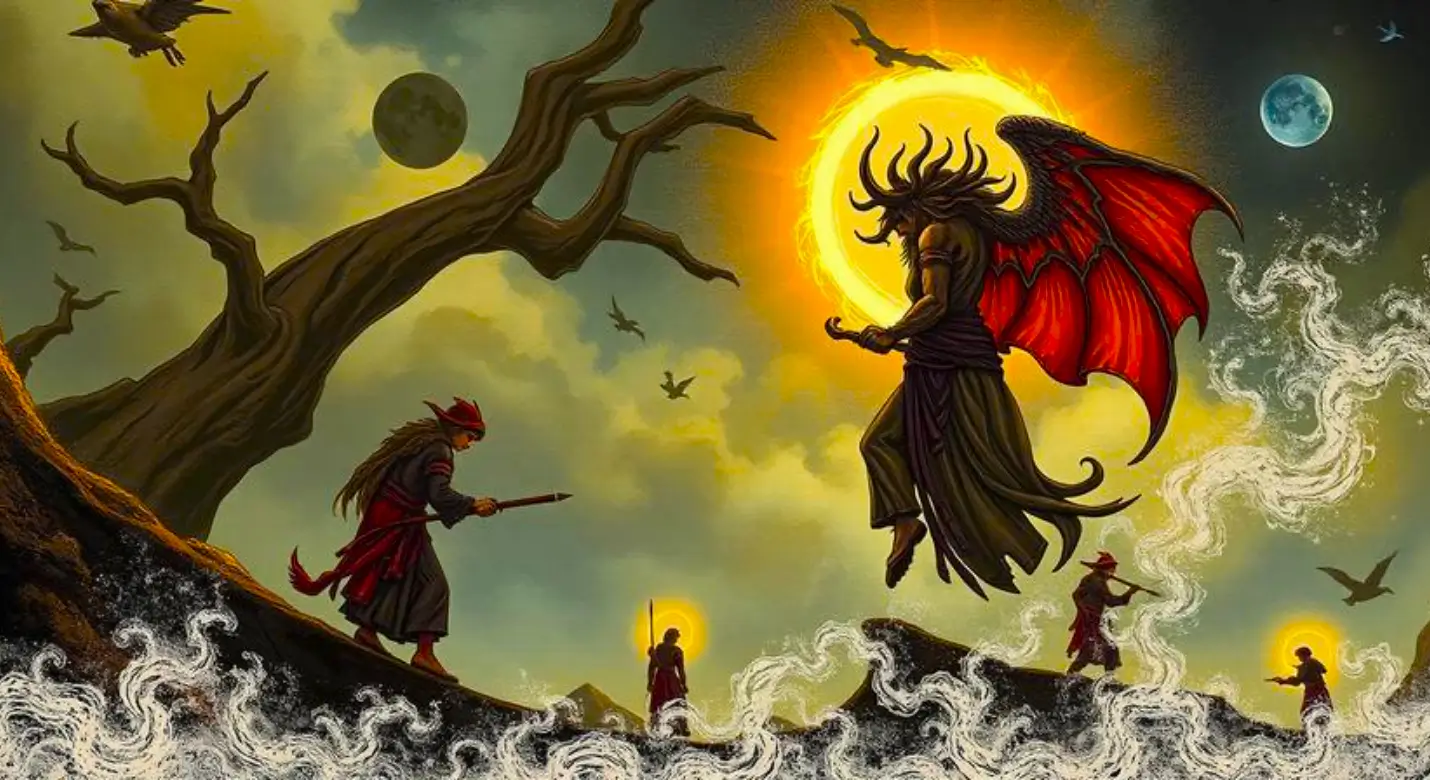
Folktales cross borders through migration, trade, translation, and oral retelling—each journey reshaping stories while preserving their cultural core.

What Are Folktales and How Are They Transmitted?
Folktales are traditional prose narratives shared by word of mouth within communities, serving as entertainment, moral instruction, and collective memory. Unlike authored literature, they have no single original text; every telling is a performance of an older pattern. Those interested in the wider field can learn more about folklore and legends in Lore Unbound's reference library.
Oral Tradition and Performance
Memory and performance keep oral tales alive. Tellers rely on repetition, rhythm, and familiar formulas to remember long narratives and guide the audience through the story.
A folktale changes each time it is told. A storyteller shortens, expands, or reorders events depending on the audience, the occasion, and the mood of the moment.
Variation is therefore not corruption. It is the normal operation of oral tradition and the main reason stories can travel: a new audience always receives a story adjusted to its expectations.
- Key features of oral transmission include variation as the norm, mnemonic formulas, audience participation, fusion of local and foreign motifs, and portability across generations.
Written Transmission and Translation
Writing and translation expanded the reach of oral tales. Collections such as the Sanskrit Panchatantra and the Arabic One Thousand and One Nights circulated across Asia, Africa, and Europe through manuscript copying and translation.
Translators routinely adapted names, landscapes, animals, and morals to their own readers. The same fable could appear with different characters and different lessons in different languages.
Printed books and school textbooks later fixed some versions as canonical, but these versions still crossed borders and continued to mix with local storytelling.
- Important written channels included manuscript trade, court libraries, missionary translations, colonial schoolbooks, and illustrated children's editions.

The Main Mechanisms of Folktale Spread
Folktales move with people. Migration, commerce, pilgrimage, warfare, marriage alliances, and colonization all create contact zones where narratives are exchanged.
Migration, Trade, and Travel
Long-distance trade routes were also storytelling routes. Caravansaries, ports, and market towns hosted travelers who brought tales from home and carried new ones onward.
The Silk Road linking China, Central Asia, and the Mediterranean, the Indian Ocean maritime network, and trans-Saharan trade transmitted narratives alongside goods.
Sailors, merchants, pilgrims, and soldiers were the live carriers of these stories. A tale heard in one port could be retold in the next.
- Major channels over time include overland trade routes, maritime networks, pilgrimage routes, royal courts, and seasonal labor migration.
Religion, Empire, and Cultural Contact
Religious traditions also carried folktales. Buddhist Jataka tales, Christian saints' legends, and Islamic story collections mixed instruction with entertainment and crossed linguistic frontiers.
Missionaries and translators often adopted local storytelling forms to reach new audiences, introducing foreign narrative patterns into local traditions.
Colonial and imperial systems created unequal but powerful cultural exchanges. Colonizers brought their folklore, while local collectors recorded the tales of the colonized, sometimes reshaping them in the process. Readers may explore more religions and belief systems to understand these exchanges.
- Notable examples include Buddhist monastic networks, medieval hagiography, Sufi storytelling, missionary schools, and nineteenth-century folklore collectors.

How Stories Transform at Cultural Borders
When a folktale enters a new culture, it is rarely preserved unchanged. New audiences expect familiar settings, values, and beliefs.
Localization and Cultural Adaptation
Localization replaces foreign elements with domestic equivalents. A European forest becomes a Himalayan mountain; a fox becomes a hare; a king becomes a local chief.
Motifs that make little sense in the new environment are dropped, while details that resonate locally are added. The same underlying plot can therefore support very different surface costumes.
Social values are adjusted as well. A tale that rewards cleverness in one culture might emphasize obedience, generosity, or humility in another.
- Common adaptation strategies include renaming characters, substituting local animals, changing landscapes, adjusting gender roles, and revising moral endings.
Merging with Local Beliefs
Supernatural elements in foreign tales are often interpreted through local cosmology. Witches become yakshas, djinn, saints, or forest spirits depending on the region and tradition.
Buddhist, Christian, and Islamic retellings absorbed older folktales into religious frameworks, giving them new meanings while preserving narrative suspense.
Merged narratives often re-enter circulation, creating layered stories that later scholars must disentangle with care. Interested readers can discover related myths and mythological traditions in other entries.
- Signs of merging include hybrid characters, double moral messages, anachronisms, and conflicting versions within a single tradition.

Tracking Circulation: Examples and Scholarly Interpretation
Some tales appear in so many regions that scholars have developed tools to map their movement. The Cinderella story is the most famous example.
The Cinderella Cluster and Comparative Folklore Studies
The earliest known written account resembling Cinderella is "Ye Xian," recorded in China in the ninth century by Duan Chengshi, involving a magic fish, a lost shoe, and marriage to a king.
Similar stories were later documented across Europe, the Middle East, and Asia, including versions collected by Charles Perrault and the Brothers Grimm. Whether they descend from one common source or arose independently remains an open scholarly debate.
Folklorists use the Aarne–Thompson–Uther index to classify tale types and the historical-geographic method to compare variants, but similarity alone does not prove direct borrowing.
- Comparative tools include tale-type indexes, motif indexes, translation history, linguistic dating of names, and manuscript or archaeological evidence.
| Topic or Element | Meaning, Role, or Significance | Cultural / Historical Context | Important Distinction / Context |
|---|---|---|---|
| Oral performance | Keeps stories alive through memory, voice, and audience interaction; each telling creates a new variant. | Found in nearly all societies, especially pre-literate communities and contemporary storytelling circles. | There is no fixed "original text"; variation is a normal feature of oral transmission. |
| Migration and trade | Carry tales across geographic and linguistic frontiers through direct human contact. | Silk Road, Indian Ocean routes, trans-Saharan trade, and pilgrimage networks. | Routes can be documented, but individual story journeys often leave no visible trace. |
| Translation and publication | Allow stories to reach new readerships while adapting names, settings, and lessons. | Panchatantra, One Thousand and One Nights, Aesop's fables; print and schoolbooks from early modernity onward. | Translations create distinct local versions; a famous later retelling may overshadow earlier forms. |
| Comparative folklore research | Uses tale-type and motif indexes to trace plausible paths of transmission and variation. | Aarne–Thompson–Uther index (updated 2004); historical-geographic method in twentieth-century folklore studies. | Classification is an analytical tool: it does not prove a single origin or direction of spread. |
| Digital and global media | Spread standardized versions worldwide, increasingly displacing local variants. | Film, television, streaming, and internet platforms from the twentieth century onward. | Global versions can create a false impression that one "original" version exists. |
Scholars generally distinguish between diffusion, the spread of a tale from one center, and polygenesis, the independent invention of similar tales under similar social conditions. Most major folktale traditions probably involve both processes at different moments. Those interested in visual and conceptual connections can explore symbols and their meanings across cultures.

Conclusion: What Folktale Travel Teaches Us
Folktales spread through the same channels as people, goods, and ideas: oral performance, migration, trade, religion, translation, and modern media. Each crossing transforms the story as it adopts local names, settings, values, and beliefs.
Understanding transmission means respecting both unity and diversity. Recognizable narrative patterns connect distant cultures, while each regional variant reflects its own historical experience. Lore Unbound is an independent global encyclopedia devoted to these connections across human culture.
Readers who wish to go deeper can explore Lore Unbound for related myths, legends, traditions, and beliefs. For a summary of research and neutrality principles, see Lore Unbound's editorial policy.
This content was created with the assistance of Artificial Intelligence as an editorial tool and reviewed by Pedro Neves in accordance with Lore Unbound's editorial standards for clarity, neutrality, cultural context, responsible sourcing, and the distinction between documented evidence, scholarly interpretation, religious belief, mythology, folklore, legend, and traditional narrative. The content is prepared following Lore Unbound's editorial guidelines and quality standards for SEO, GEO, and Artificial Intelligence answer systems.
FAQ About How Do Folktales Spread Between Cultures?
What does it mean for a folktale to spread between cultures?
Spread refers to the process by which traditional narratives travel from one community or region to another through contact, exchange, migration, trade, conquest, or media. It is not a single event but an ongoing transmission and adaptation. When a tale enters a new culture, it often changes to fit local beliefs, social norms, language, and environment.
What are the main ways folktales move from one culture to another?
Main pathways include oral storytelling through face-to-face contact, migration and displacement of peoples, trade routes and merchant networks, pilgrimage, diplomatic exchanges, intermarriage, conquest and colonization, religious missions, and later written collections, translations, print media, film, and internet. Often several pathways combine over time.
How do oral traditions allow folktales to cross cultural boundaries?
Oral storytelling relies on memory, performance, and audience participation. Because storytellers retell tales in their own words and adapt details for local listeners, these narratives can easily cross linguistic and cultural boundaries. A story may be told in a border region, translated informally by bilingual storytellers, and then take root in a neighboring community. Over generations, details accumulate and shift, creating local variants.
What role did trade routes like the Silk Road play in spreading folktales?
Trade routes such as the Silk Road connected regions across Asia, the Middle East, and Europe, carrying not only goods but also stories, motifs, and storytelling traditions. Merchants, travelers, caravanners, and sailors exchanged tales in marketplaces, caravanserais, and ports. The presence of shared motifs in widely separated cultures is often attributed to such long-distance contacts, though scholars also acknowledge independent invention and parallel development.
How did colonialism and missionary activity affect the spread of folktales?
Colonial expansion and missions brought European folktales to the Americas, Africa, Asia, and Oceania, while also transmitting Indigenous stories to European scholars and audiences. Colonial powers often imposed their languages and narrative frameworks, sometimes reshaping local tales. At the same time, colonized peoples incorporated European elements into their own traditions and used storytelling as a form of resistance and cultural preservation. These exchanges were unequal and complex, with power dynamics influencing which tales were recorded, published, and studied.
What is the difference between diffusion, independent invention, and polygenesis in folktale studies?
Diffusion refers to the spread of a tale or motif from one culture to another through contact. Independent invention and polygenesis refer to similar tales arising separately in different cultures because humans share common experiences, psychology, and social needs. For many folktales, both processes are possible. Folklorists assess distribution, chronology, and historical contact to determine which explanation is more likely, but certainty is often impossible.
Why do folktales change when they enter a new culture?
A tale changes because it needs to make sense to a new audience. Names, foods, animals, landscapes, social customs, religious references, and moral values are adapted to local realities. Storytellers also respond to performance expectations and current concerns. These changes allow the tale to remain meaningful and emotionally resonant, even when its core structure or central motif stays recognizable.
What are some well-known examples of folktales that spread across many cultures?
Examples include Cinderella-type tales, which appear across Europe, Asia, the Middle East, and Africa; the story of the clever trickster such as Anansi in West Africa and the Caribbean; the animal fable tradition associated with Aesop and the Panchatantra; and the motif of the snake or dragon slayer. Different versions preserve distinct cultural details, demonstrating how a plot travels and transforms over time.
Why do different versions of the same folktale exist within one culture?
Even within a single culture, folktales are not fixed. Social groups, regions, families, and individual performers vary details, style, and emphasis. Context, such as an evening gathering, a feast, or a children's session, also influences how a story is told. These variations are normal in oral tradition and are collected by folklorists as variants that help reveal the dynamic life of a tale.
What are common misconceptions about how folktales spread between cultures?
One misconception is that a tale spreads only in one direction, from a high culture to a low culture, whereas exchange is often multidirectional. Another is that all similar tales have a single point of origin; many have multiple independent sources. A third is that oral transmission copies stories exactly; in fact, oral transmission is creative and adaptive. Also, today's global media does not simply erase local traditions; it can create new layers of adaptation, reinterpretation, and revival.
Author: Editorial Team – Lore Unbound
Reviewed by: Pedro Neves
Article produced and published in accordance with our Editorial Policy: https://loreunbound.com/editorial-policy/
Published on: September 2, 2026
Website content categories:
This content is part of the Lore Unbound editorial ecosystem, which includes:
Related Content